

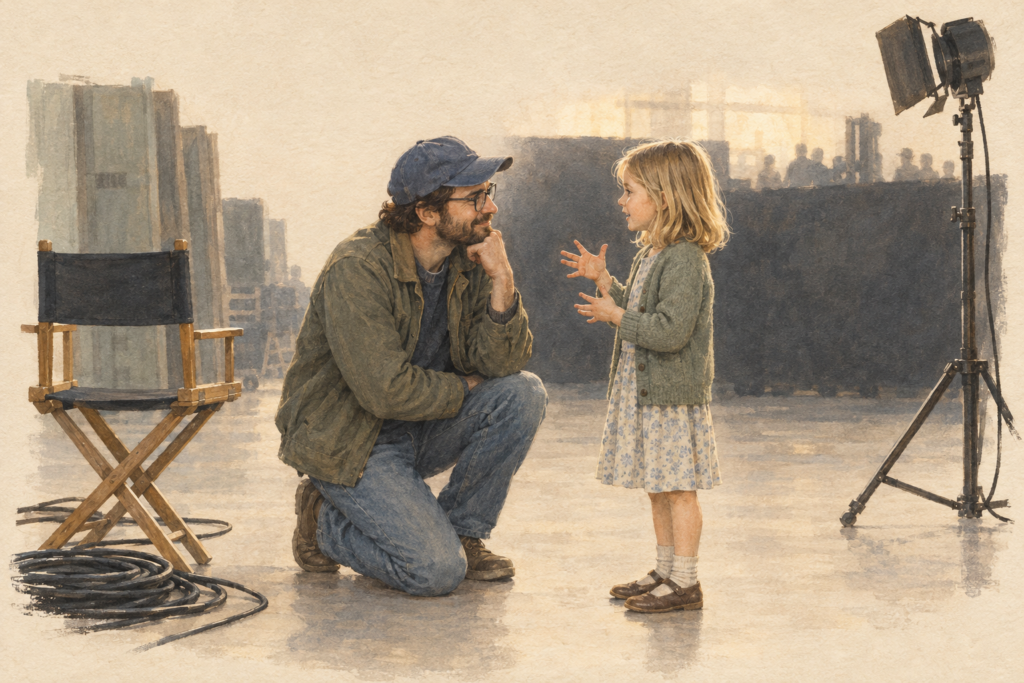
AI-generated editorial illustrations—not archival photographs.
A couple of weeks into filming E.T. the Extra-Terrestrial, Drew Barrymore noticed the crew members operating the alien and wanted them off the set.
Steven Spielberg didn’t send them away, and he didn’t explain the machinery either. He told her that E.T. was so special it had eight assistants, while he, the director, had only one. “I didn’t want to burst the bubble,” he said, according to Deadline’s account of E. Alex Jung’s 2023 Vulture profile.
That small fib says something about the decades that followed. Spielberg protected a child’s sense of wonder where he could, and he also drew a line. When Barrymore asked him to be her father, he said no. He agreed to be her godfather instead.
Neither half tells the whole story. The same profile quoted Spielberg as saying he had felt “very helpless because I wasn’t her dad.” Barrymore, in the same 2023 profile, called him “the only person in my life to this day that ever was a parental figure,” Variety reported. The relationship makes most sense when both are held together.
At a glance
- Barrymore asked Spielberg to be her father while they were making E.T. He said no and agreed to be her godfather.
- On set he kept the alien’s illusion intact for her. Off set, she spent weekends with him.
- He has described feeling helpless about her childhood because he was not her parent.
- In 2025 he said that making E.T. made him want to become a father.
The secret he kept for her
Barrymore was six during filming, CNN reported, and she has said that a red cowboy hat she kept from the set reminds her of being that age. The film opened in 1982.
Spielberg worked to keep the magic intact for her. As Variety summarised the profile, she believed E.T. was real, and he wanted to keep it that way. He kept operators on hand during breaks, so that she could eat lunch with E.T.
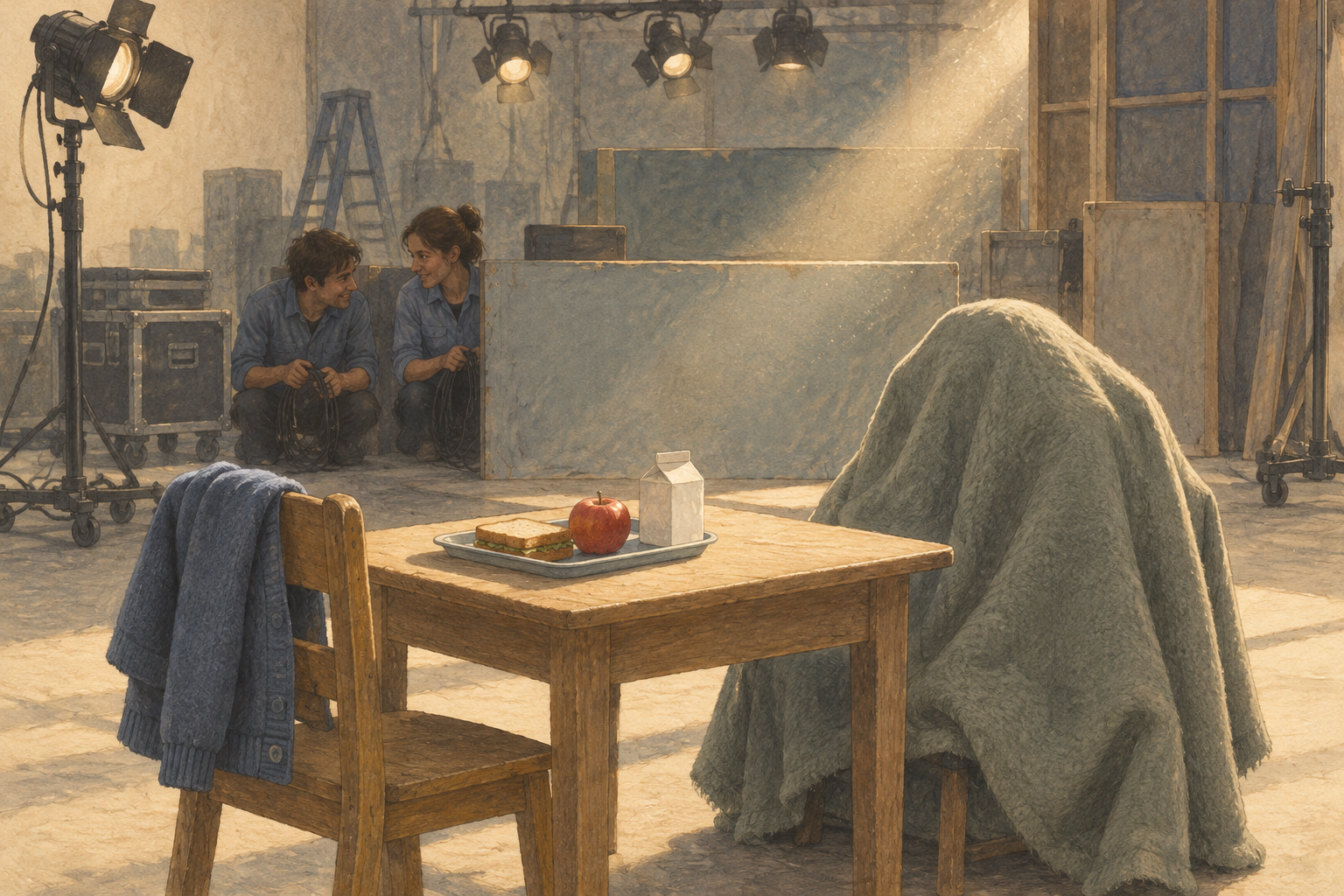
Read one way, this is a director protecting a performance. Read another, it is an adult letting a six-year-old stay six a little longer, on a set full of adults doing a job. The accounts record what he did. They don’t settle which motive mattered more.
For another look at puppetry, imagination and kindness in entertainment made for children, see Jim Henson’s legacy of kindness.
She repaid the trust with invention. At a 2025 event in New York, Spielberg recalled that, with the camera rolling, she said, “I don’t like his feet.” “We used it,” he said, as CNN reported, citing PEOPLE. She made up a lot of her own dialogue, he added, because she was “irrepressible.”
The question he answered with “no”
While they were making the film, according to reports on the profile, Barrymore asked Spielberg whether he could be her father. He said no. She then asked whether he could be her godfather, and he agreed.
None of the accounts says why he refused. One reasonable reading is that he was declining a role he could not honestly take on. He was her director, not her parent, and being her godfather was something he could actually do.
In practice the role seems to have meant time and attention. She spent weekends with him; he took her to Disneyland and Knott’s Berry Farm and gave her a cat, which she named Gertie. Decades later she described those weekends herself: “I would spend weekends at his house, and he was always showing movies,” she recalled, in remarks Business Insider reported in January 2025.

It also meant the occasional rule. When she came to set wearing red lipstick, he told her to take it off. She has also recalled him persuading her to wait until she was 10 to have her ears pierced.
Rules like these are the kind a parent gives without much thought. They suggest that he was treating her as a child, not as a small professional.
What a godfather could not fix
The line he drew also marked the edge of what he could do.
Barrymore’s father, the actor John Drew Barrymore, was not a safe presence in her early life; she has described him as abusive. Spielberg was not her legal parent. By his own account, that limited how far he could step in.
In the remark quoted in the 2023 profile, he said she had been “living a life at a very tender age that I think robbed her of her childhood.” The role left to him was narrower: “I could only kind of be a consigliere to her,” he said.
Consigliere is a careful word. It means an adviser who can counsel but not command.
She has since spoken openly about how difficult her childhood became. Nothing in these accounts suggests that his care prevented what came next, and it would flatten the story to claim it did.
What his care did offer is harder to measure. The clearest evidence comes from Barrymore herself, decades later.
“The first person I knew cared”
On 22 February 2021, her 46th birthday, Savannah Guthrie hosted a tribute episode of The Drew Barrymore Show. When the conversation turned to Spielberg, Barrymore grew emotional and said, “he’s like the first person I knew cared,” TheWrap reported.
Then Spielberg appeared by video, and she broke down in tears. “Oh Drewface, I still care about you,” he said. He remembered the “little blonde hurricane” who had walked into an audition in his office.

She told him she had always thought about how he would feel about the things she did well. “I lived to make you proud,” she said.
That line is the quiet centre of the story. A godfather could not run her life, but he could become someone she measured herself against.
The influence that ran the other way
Mentorship stories usually travel in one direction. This one did not.
On 25 January 2025, the two appeared together on a TCM Classic Film Festival panel at 92NY in New York, moderated by Dave Karger. Us Weekly, Business Insider and CNN all credited PEOPLE for what Spielberg said there. As Us Weekly relayed it, he told the audience that until then he had just been making movies, and that “making E.T. made me want to be a father for the first time.”
“I didn’t ruin that for you?” Barrymore asked. “The opposite,” he replied.
Business Insider noted that he had made a similar comment at the same festival in 2022, and that his first child, Max, was born in 1985. Reacting on The Late Show with Stephen Colbert, Barrymore offered her own version: “He always called me his training wheels for parenthood.”
She talked about what the film meant to her, too. It was the one that changed her life, she said, in remarks Us Weekly reported from the panel: “Everything in my life is about how I got believed in by one human being.”
Her own parenthood carries an echo of that set. The red cowboy hat, she said on her show in 2020, is “in the girls’ room somewhere.” Parents, she suggested, can put something of theirs in their children’s rooms, “so it’s a transference of memories and energy,” as CNN reported.

She didn’t link the hat to Spielberg. Still, it comes from the set where a director chose to protect her belief in an alien rather than explain the machinery.
What the story shows, and what it doesn’t
The record supports a modest reading. In this case, a caring adult who was not her parent did not rescue her from what followed, and Spielberg did not claim he could. He turned down one role and accepted another. Then he kept turning up: weekends, small house rules, a cat, a birthday message almost four decades later and a shared stage in 2025.
It does not show that one good adult outweighs everything else in a child’s life. Barrymore credits other people too. As an adult, she also found support in Jennifer Garner, whom she described as a woman who “really saved” her in the 2023 profile.
What it does show is that, here, a boundary and real care came from the same person. He told her no, then spent decades showing what his yes meant.
In Spielberg’s story, E.T. had eight assistants. Drew Barrymore had one director who would not pretend to be her father, and who kept showing up anyway.
More relationship stories on Evolvarium: Charlie and Shirley Watts’s long marriage and Ruth and Marty Ginsburg’s marriage of taking turns.
Sources
This story relies on published reporting. It draws on no original interviews and no viewing of the broadcasts themselves.
- E. Alex Jung, “Drew Barrymore Is Figuring It Out Live”, Vulture, 5 June 2023. This is the original reported profile. Its E.T. passages are quoted here as they were carried by Deadline and Variety.
- Armando Tinoco, “Steven Spielberg Says He Felt ‘Helpless’ Over Drew Barrymore While Filming ‘E.T.’ ‘Because I Wasn’t Her Dad’”, Deadline, 6 June 2023. A report on the Vulture profile.
- Zack Sharf, “Steven Spielberg ‘Felt Helpless’ Watching Drew Barrymore Being ‘Robbed of Her Childhood’ While Making ‘E.T.,’ but ‘I Wasn’t Her Dad’”, Variety, 6 June 2023. A report on the Vulture profile.
- Andi Ortiz, report on Spielberg’s appearance on Barrymore’s birthday episode, TheWrap, 22 February 2021.
- Alli Rosenbloom, “Steven Spielberg remembers 6-year-old Drew Barrymore was an improv pro on set of ‘E.T.’”, CNN, 27 January 2025. It covers the January 2025 panel, citing PEOPLE, and a 2020 episode of The Drew Barrymore Show.
- Kristie Lau-Adams, “Steven Spielberg Says Directing Drew Barrymore in ‘E.T.’ Made Him Want ‘To Be a Father for the 1st Time’”, Us Weekly, 26 January 2025. Its panel quotations are credited to PEOPLE.
- Ayomikun Adekaiyero, “Steven Spielberg said Drew Barrymore made him want to be a parent. She calls the ‘E.T.’ director a ‘father figure.’”, Business Insider, 29 January 2025. It covers the panel, citing PEOPLE, and Barrymore’s Late Show response.
CodeSight Media is the editorial byline used for this Evolvarium profile. About Evolvarium · How we research and illustrate our stories · Report a correction
Leave a Reply