

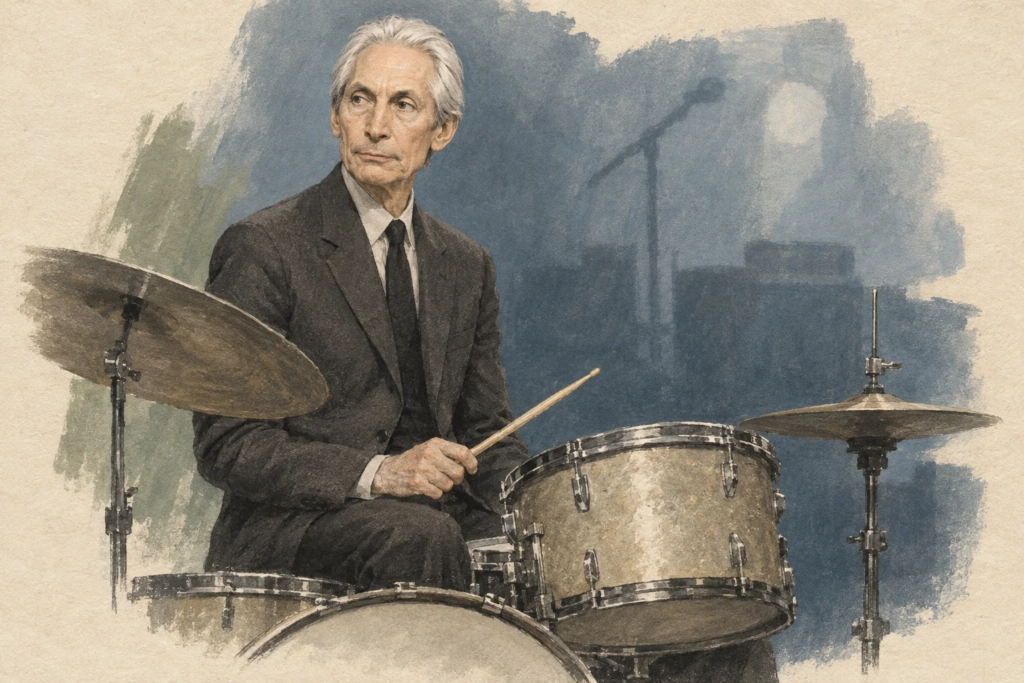
All images in this article, including the portrait at the top, are AI-generated editorial illustrations. They are interpretations, not archival photographs, and the scenes are symbolic rather than records of real places or events.
On 14 October 1964, Charlie Watts married Shirley Ann Shepherd at the register office in Bradford, Yorkshire. The other Rolling Stones were not told, and the newlyweds celebrated with a modest pub lunch afterwards, as the Associated Press reported in 2022. The press broke the story on 20 November, according to Bill Wyman’s Rolling Stones chronology.
When the reports appeared, Watts at first denied them. He told the Daily Express that “it would do a great deal of harm to my career if the story got around.” Shirley confirmed the news, saying they could not “bear to live separately any longer.” AP draws both remarks from Paul Sexton’s 2022 biography Charlie’s Good Tonight.
The marriage lasted until his death in 2021, almost 57 years later. Watts spent nearly six decades as the Rolling Stones’ drummer, yet the life he built with Shirley rested on other things: art school, jazz and horses.
Art school, design and jazz before the Stones
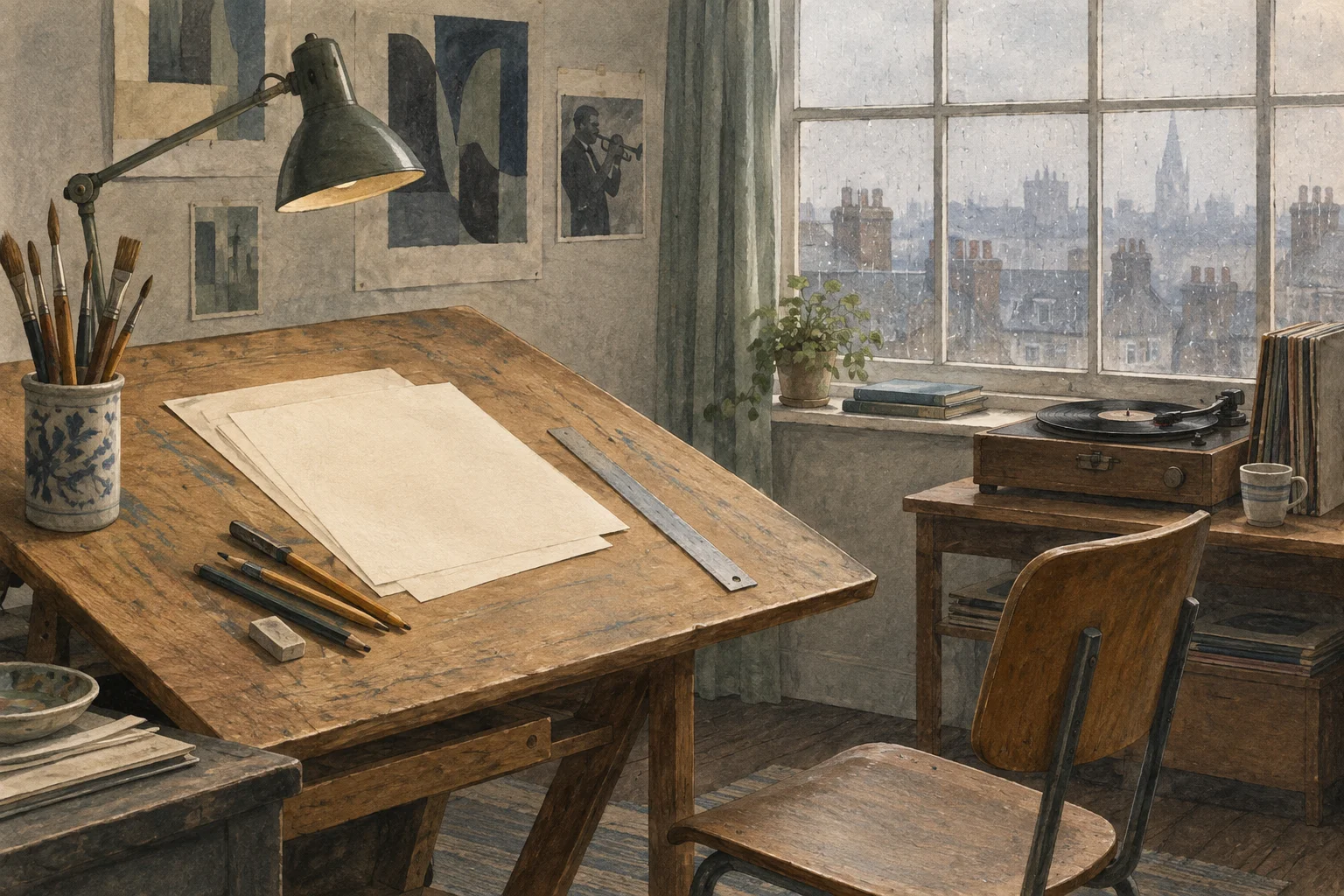
Watts was a designer and a jazz listener before he was a rock drummer. Born on 2 June 1941 at University College Hospital in London, he grew up in a prefabricated house in Kingsbury, the son of a lorry driver, as the BBC’s obituary records.
He had a gift for art as a schoolboy and went on to Harrow School of Art. From there he moved into design work at a London advertising agency, a job The Irish Times dates to 1960.
Music ran alongside the design work. He was 13 when his parents gave him a drum kit, and he practised by drumming along with his jazz records. It was Chico Hamilton’s brushwork on “Walking Shoes” that first drew him to the instrument, according to a separate BBC report.
His student years also produced Ode To A High Flying Bird, an illustrated biography of the saxophonist Charlie Parker that he made at art college. It would resurface in his music decades later.
The jazz drummer inside a rock band
Watts reached the Rolling Stones through London’s club scene. Alexis Korner heard him drumming around the clubs and pubs and invited him into Blues Incorporated, where a guitarist named Brian Jones was also playing. Jones brought him to the young Rolling Stones, and Watts joined in January 1963. He remained a member for the rest of his life, as the BBC’s reports make clear.
The BBC sums up how he described life with the Stones: five years of playing and 20 years of hanging around.
Jazz stayed at the centre of his musical life. He enjoyed rock drumming, yet jazz gave him “more freedom to move around,” a line of his the BBC obituary quotes. In 1990 Ode To A High Flying Bird became the starting point for a musical tribute to Parker, released on an album by the Charlie Watts Quintet.
That parallel career kept growing. He assembled the Charlie Watts Big Band from leading British jazz musicians. Watts at Scott’s, a 2004 live album by the Charlie Watts Tentet recorded at Ronnie Scott’s in London, came out at the same moment that word spread of his surgery and radiotherapy for throat cancer. Treatment worked, and the cancer went into remission. From 2009 he also played with the ABC&D of Boogie Woogie, The Irish Times notes.
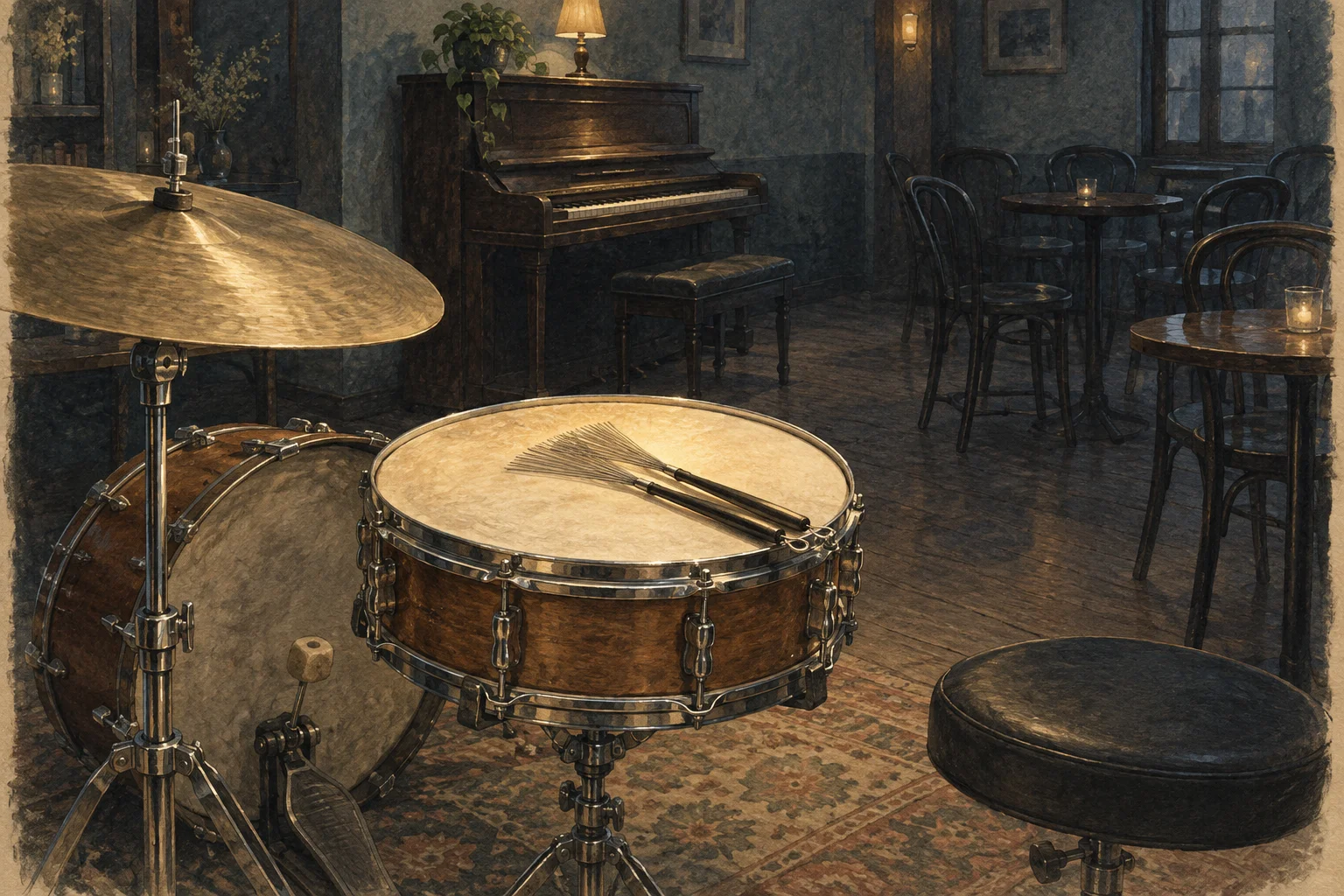
His design training stayed useful inside the band. The BBC credits him with the cover art for Between the Buttons (1967) and with helping to design the Stones’ concert staging. Promoting the band’s 1975 US tour with a performance from the back of a moving truck in Manhattan was his idea too, one he took from New Orleans jazz bands.
Shirley Shepherd and a wedding kept quiet
Shirley Ann Shepherd was born in London in 1938, and in the early 1960s she was studying sculpture at the Royal College of Art, AP reported. PA Media says the two met while she was there, dates their meeting to 1961, and describes Watts at the time as “a graphic designer and part-time jazz musician”.
Watts later spoke warmly about what drew him to her. “She was so funny and clever, and she had the most infectious laugh you’d ever heard,” he told The Guardian in 2000, in remarks AP quoted after her death. “And I loved the world she was in, the world of art and sculpting. I just admired Shirley very, very much.”
The relationship came before the fame: AP says the two were already a couple by the time Watts became a Rolling Stone, early in 1963. The Bradford wedding followed about 21 months later, the secret lasted a little over five weeks, and their daughter, Seraphina, arrived in 1968, four years after the wedding.
Touring, addiction and the years that tested the marriage
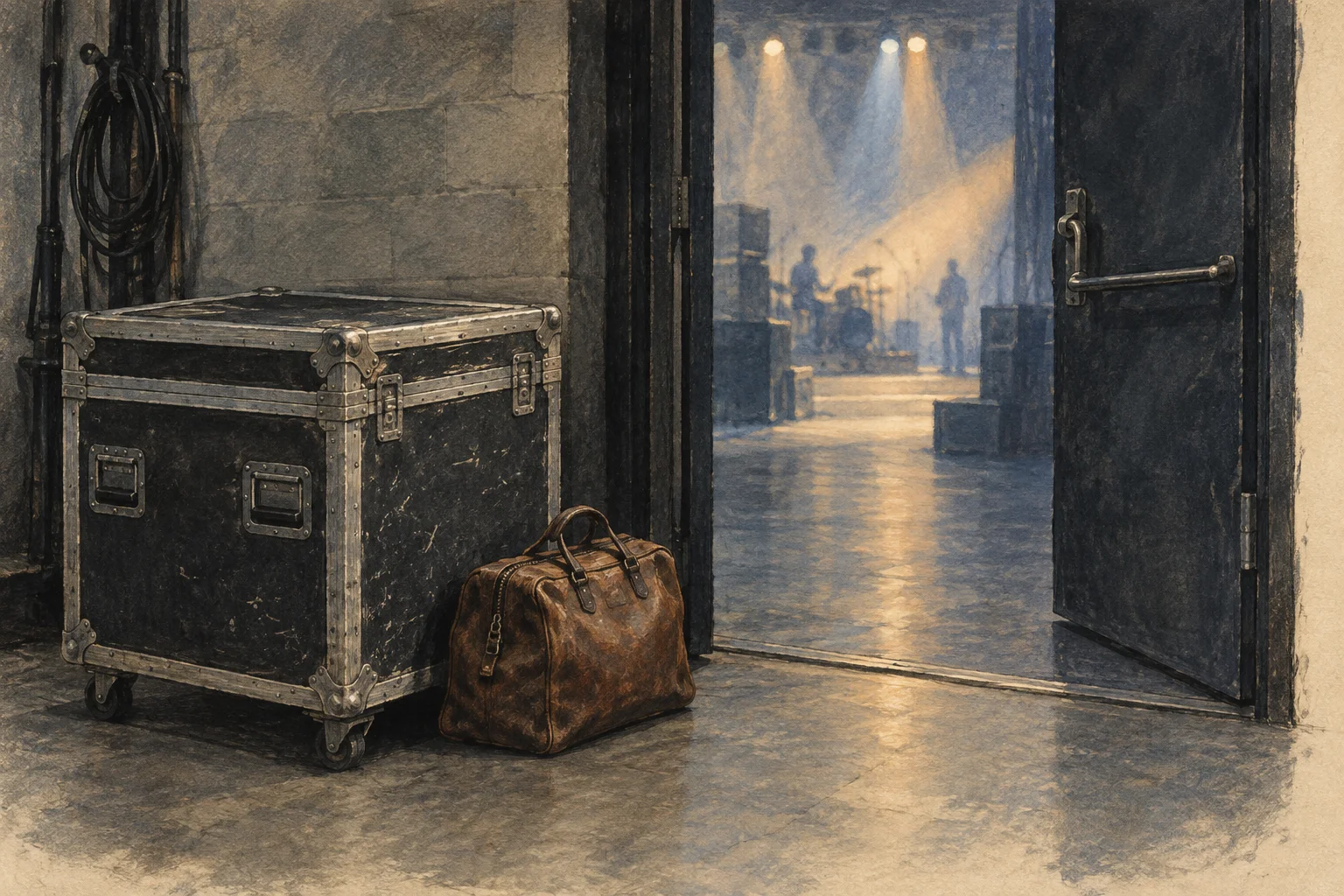
Watts’s habits on the road set him apart from his bandmates. He turned away the groupies who trailed the Stones from tour to tour and stayed faithful to Shirley, the BBC’s obituary notes.
The serious trouble came in the mid-1980s. According to the BBC obituary, Watts began drinking heavily and taking drugs in those years and became addicted to heroin; he attributed the episode to a mid-life crisis. The Irish Times places the start in 1985, during the Dirty Work sessions, when Jagger and Richards were feuding and nobody could be sure the band would last.
Watts could later joke about how far it went. “It got so bad,” he quipped in a line preserved by the BBC obituary, “that even Keith Richards, bless him, told me to get it together.”
He was also direct about the cost. “I was mad on drink and drugs. I became a completely different person, not a nice one. I nearly lost my wife and family and everything,” he said in a later interview quoted by the Irish Times. AP adds that he came to say the addiction had almost cost him his marriage.
Shirley was fighting alcoholism of her own in the same period, as both the BBC and AP record, and AP credits the hours she spent sculpting horses and dogs with helping her beat it.
Watts got himself off drugs without fuss, by the Irish Times’s account. The BBC puts the recovery in more personal terms: “it was Shirley, above all, who helped him get through it.”
Shirley’s world: horses, sculpture and Devon
Later the family moved to Devon, where, PA reports, Shirley “ran a world-class Arabian stud farm”. She “went on to become highly respected as a breeder and show person in the International Arabian horse community,” the same report says. The farm was called Halsdon Arabians, and sheepdogs were bred on the estate as well, according to the Irish Times.
Away from touring and recording, AP reported, home was a 600-acre Devon estate dating from the 16th century, and the family became known for their Polish Arabian horses and for rescue work with animals. The shared enthusiasm started with collecting figurines; after Charlie gave Shirley a part-bred stallion, it eventually extended to hundreds of Arab horses.
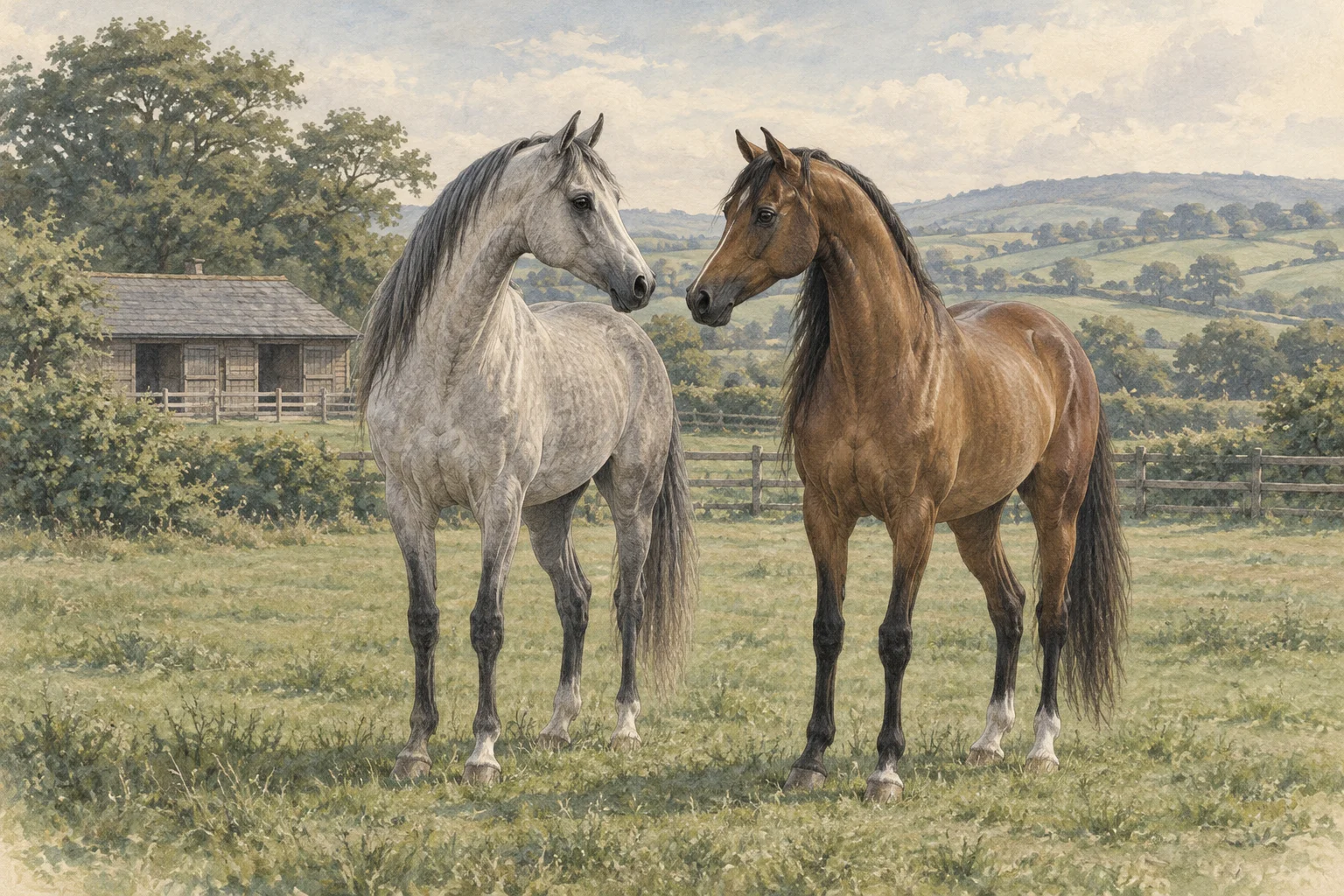
Shirley’s commitment to animals reached beyond the farm. In 2016 she threatened legal action against Polish government officials over the alleged mistreatment of two Arabian mares at a state-run farm, AP reported. After her death, PA described her as “an accomplished sculptor and huge supporter of animal rescue.”
Watts had plenty of other enthusiasms. Talking with him might take in Savile Row tailoring, cricket and the Arabian horses he and Shirley raised, the Irish Times remembered, though “he would invariably come back to jazz.”
“Not really a rockstar”: Watts on fame and a long marriage
In February 2018, NME’s Alex Flood pointed out that Watts had been married for 54 years, “rare for a rockstar”, and asked for his secret. Watts answered: “Because I’m not really a rockstar. I don’t have all the trappings of that. Having said that, I do have four vintage cars and can’t drive the bloody things.”
He made the same point elsewhere, in words the BBC’s obituary quotes: “It’s supposed to be sex and drugs and rock ’n’ roll. I’m not really like that. I’ve never really seen the Rolling Stones as anything.”
The BBC also quoted what he told the San Diego Tribune in 1991: “There are people who just play instruments, and I’m pleased to know that I’m one of them.”
For another long marriage in the public eye, read how Michael Caine’s long marriage began.
Two deaths, less than 16 months apart
Charlie Watts died on 24 August 2021, aged 80. In a statement reported by the BBC, the Rolling Stones’ publicist said that “He passed away peacefully in a London hospital earlier today surrounded by his family.” The statement called him “a cherished husband, father and grandfather”. He was survived by Shirley, their daughter Seraphina and his granddaughter Charlotte.
By then he and Shirley had been married for almost 57 years, from the Bradford register office in October 1964 to his death in August 2021.
Shirley Watts died on 16 December 2022. Her family’s statement, shared with PA, said: “Shirley died peacefully on Friday December 16 in Devon after a short illness surrounded by her family.” It was issued in the names of daughter Seraphina, granddaughter Charlotte and son-in-law Barry.
The statement ended with one line: “Reunited now forever with her beloved Charlie.”
Where published accounts differ
A few details of the couple’s story vary between reports, or circulate online in forms the sources do not support.
- Length of the marriage. From the wedding on 14 October 1964 to Charlie’s death on 24 August 2021 is 56 years and about 10 months. PA describes it as 57 years, a common rounding; this profile says “almost 57”.
- Shirley’s age at death. AP gave her age as 84, consistent with the 1938 birth year it reports. PA gave 82. This profile gives the date of her death rather than an age.
- When Watts joined Blues Incorporated. The BBC says Alexis Korner heard him in 1961; the Irish Times says Korner recruited him in 1962.
- Her birth surname. AP, PA, the Irish Times and Bill Wyman’s chronology all spell it Shepherd, not Shepard.
- An untraced quote. A widely shared claim that Watts called time away from home his greatest regret could not be traced to an original interview for this profile, so it is not included.
Key dates
| Date | Event |
|---|---|
| 1938 | Shirley Ann Shepherd is born in London (AP). |
| 2 June 1941 | Charles Robert Watts is born at University College Hospital, London (BBC). |
| January 1963 | Watts joins the Rolling Stones (BBC). |
| 14 October 1964 | Charlie and Shirley marry at the register office in Bradford (Bill Wyman chronology; AP). |
| 20 November 1964 | The marriage is revealed in the press (Bill Wyman chronology). |
| 1968 | Their daughter, Seraphina, is born (PA; The Irish Times). |
| Mid-1980s | Watts’s period of drink and drug addiction, which the BBC says Shirley above all helped him through (BBC; The Irish Times). |
| 2004 | Watts is treated for throat cancer, which goes into remission (BBC; The Irish Times). |
| 24 August 2021 | Charlie Watts dies in a London hospital, aged 80 (BBC). |
| 16 December 2022 | Shirley Watts dies in Devon after a short illness (PA). |
Related reading on Evolvarium: Gilda Radner and Gene Wilder’s story of resilience and legacy, Hubert de Givenchy and Audrey Hepburn’s creative partnership and how a chance night in a pub inspired Mark Knopfler.
Sources
- BBC News, “Charlie Watts obituary: Jazz man who became rock superstar”, 24 August 2021.
- BBC News, “Charlie Watts: Rolling Stones drummer dies at 80”, 24 August 2021.
- The Irish Times, “Charles Watts obituary: The sensible Rolling Stone”, 28 August 2021.
- NME, Alex Flood, interview with Charlie Watts, 28 February 2018.
- Associated Press, Hillel Italie, “Shirley Watts, widow of drummer Charlie Watts, dies at 84”, syndicated by KSAT, 19 December 2022. AP cites Paul Sexton’s 2022 biography Charlie’s Good Tonight for the Daily Express quote.
- PA Media, Mike Bedigan, report on Shirley Watts’s death, via Echo Live, 19 December 2022. The report gives her age as 82 and the marriage as 57 years.
- Bill Wyman official site, Rolling Stones chronology, undated.
About this article. This profile was written by CodeSight Media for Evolvarium from the published sources listed above. No interviews were conducted. The images are AI-generated illustrations made with an OpenAI image model, as noted in each caption; they are not photographs. Read more about Evolvarium and the site’s disclaimer. Factual corrections can be sent through the contact page.
Leave a Reply